Description
THE GAZE THAT REMEMBERS
Original Mixed-Media Portrait by Carlos Kahan
A face emerges through color, fiber, and memory.
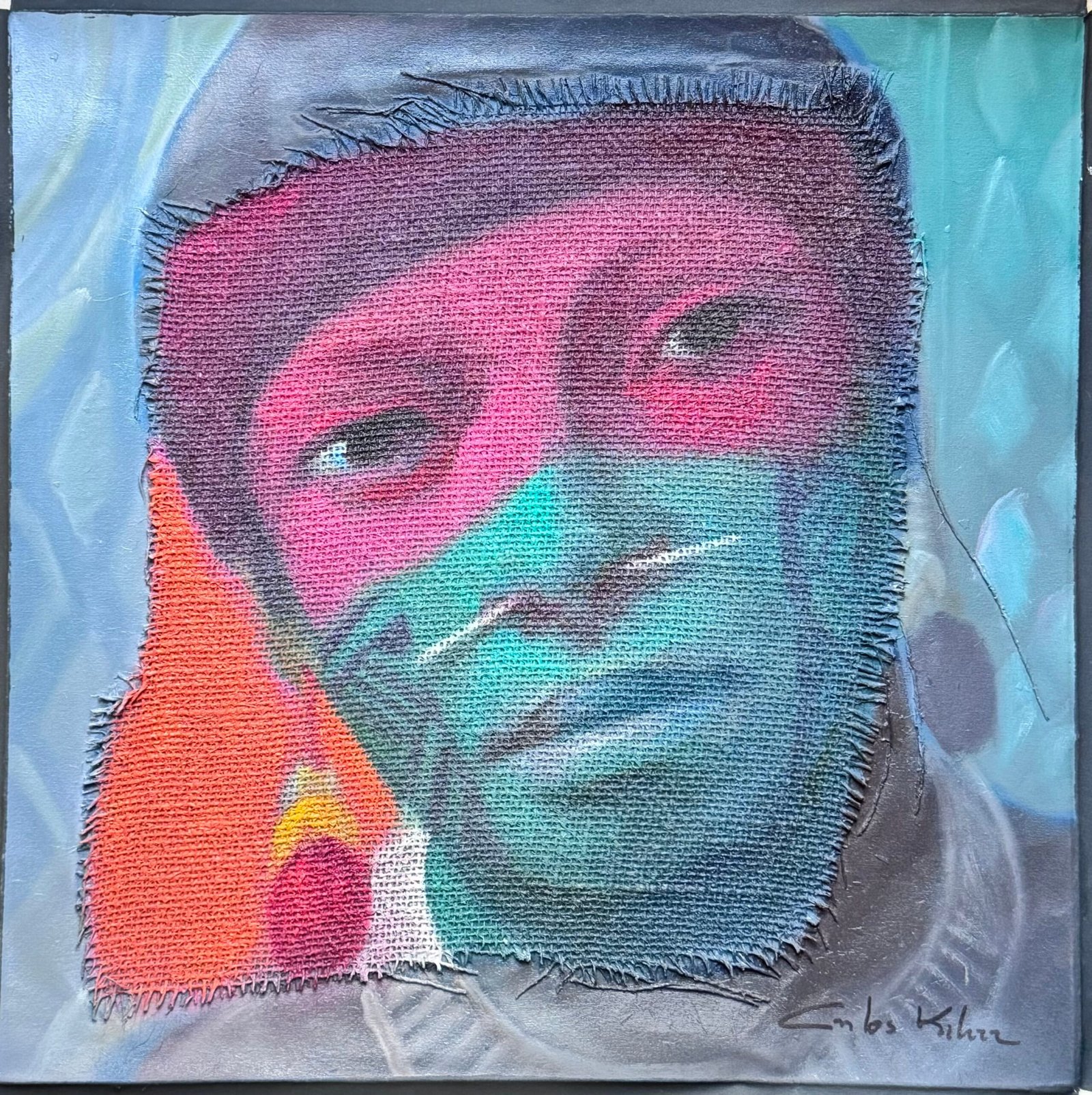
In The Gaze That Remembers, Brazilian artist Carlos Kahan presents a monumental presence within an intimate square. The figure turns toward us without fully surrendering to our gaze. One eye meets the viewer; the other appears to look beyond the visible—as though listening to something carried from another time.
Magenta moves across the forehead like heat at dusk. Turquoise illuminates the center of the face before descending into deep blue-green shadow. At the left, a narrow field of red-orange burns like an ember beside a small burst of yellow, crimson, and white. Cool blue surrounds the portrait, allowing the warmer colors to pulse with even greater force.
This is not simply a study of likeness. It is a meditation on presence.
The Spirit of the Work
The portrait feels both immediate and ancient.
The open weave of the textile allows the face to breathe through its material. Threads remain visible. The perimeter is deliberately frayed and irregular, refusing the polished silence of a conventional border. The fabric becomes skin, veil, archive, and threshold.
Across many African and African-diasporic traditions, cloth can carry far more than decoration. It may communicate belonging, passage, labor, status, ceremony, protection, and remembrance. Kahan does not illustrate one specific tradition here. Instead, the tactile textile invites a broader contemplation of how identity is carried: through the body, through material, and through what survives at the edges.
The figure’s asymmetrical gaze gives the work its spiritual tension. The visible eye does not perform for the viewer. It observes. It weighs. It remembers. The portrait therefore resists becoming an exoticized “type.” The subject retains an interior world that remains sovereign.
This is a face that asks to be met, not consumed.
Material Language
Kahan’s use of a coarse, visibly woven textile is essential to the emotional force of the work. Its grid-like structure sits close to the surface, interrupting any illusion of photographic smoothness. The image is built through both pigment and fiber.
The textile fragment appears physically layered over a painted support. Its darkened, uneven edges frame the face without enclosing it. Beneath and around it, translucent blue-grey passages and faint linear marks create a quieter atmospheric field.
The contrast between these layers produces a distinctive visual rhythm:
- woven texture against fluid painted color;
- saturated heat against cool atmosphere;
- sharply concentrated facial presence against an open, elusive ground;
- controlled portraiture against deliberately unfinished edges.
The result is at once painting, textile object, and intimate monument.
Color and Composition
The nearly square format concentrates the viewer’s attention. The head fills most of the composition and is slightly tilted, bringing the encounter unusually close.
Color is expressive rather than strictly naturalistic. Magenta, turquoise, indigo, orange, and blue-grey divide the face into zones of heat, shadow, and illumination. These colors do not mask the subject’s humanity; they intensify it. Their movement across the features suggests shifting emotional and spiritual states—fire and water, flesh and night, immediacy and remembrance.
A narrow red-orange passage on the left functions like an inner flame. The surrounding blue field offers breath and distance. Between them, the face becomes a meeting place for opposing forces.
About Carlos Kahan
Carlos Kahan was born in São Paulo, Brazil, on May 9, 1959. His artistic formation began early: archival biographical material records his studies in artistic drawing and live-model anatomy in the studio of German-born Brazilian painter Walter Lewy. Although trained in drawing, Kahan developed his approach to painting independently, studying and reinterpreting European masters before forming his own visual language.
Kahan’s work eventually turned decisively toward Black portraiture and toward the cultural relationship between Bahia and Africa. He has described studying African peoples—among them Fulani communities—and drawing upon clothing and ornament as points of departure for newly imagined figures. A recurring source within his portrait vocabulary is Tereza, a Black Brazilian woman who became his first live Black model and whose features have continued to echo through his work.
After a serious automobile accident in 1993, Kahan lost the sight in his left eye and retained limited sight in the other. He has explained that this changed the physical scale of his practice: small figures became difficult to paint, so his subjects grew larger. What began as an adaptation became one of the defining qualities of his art. Faces occupy the field with unapologetic authority.
Kahan lived and worked in Salvador for many years, becoming especially associated with the Pelourinho and its Afro-Bahian cultural landscape. His large painted doors and public-facing portraits in the historic district transformed deteriorating architectural surfaces into sites of Black visibility. The works became widely photographed landmarks, extending his portrait practice from the private canvas into the shared life of the street.
His career includes recognition in the Bahia Marinhas salons, participation in Salvador Shopping’s Circuito de Moda e Arte, exhibitions in Brazil, and inclusion in the Imago Mundi collection and its Brazil: Land of the Future catalogue. That publication described his work as creating an analogy between Bahian culture and its African origins.
Kahan’s artistic language is therefore inseparable from three forces: the discipline of portraiture, the living African inheritance of Bahia, and the artist’s determination to make Black presence impossible to overlook.
Why This Piece Matters
Created in 2024, this intimate work distills Kahan’s larger artistic concerns into a concentrated form.
The face retains the monumentality of his public murals, yet the compact scale changes our relationship to it. We must move closer. At this distance, the weave, loose threads, painted surface, and fragile perimeter become visible. Monumentality becomes intimacy; public declaration becomes private communion.
The work does not claim to reconstruct a specific ancestral identity. Its power lies elsewhere: in its affirmation that Black presence contains memory, mystery, beauty, and an interior life that cannot be reduced to appearance.
For the collector, the piece offers both visual intensity and contemplative depth. It can anchor a room despite its modest dimensions, holding the wall through gaze, color, and texture rather than physical scale alone.



Reviews
There are no reviews yet.